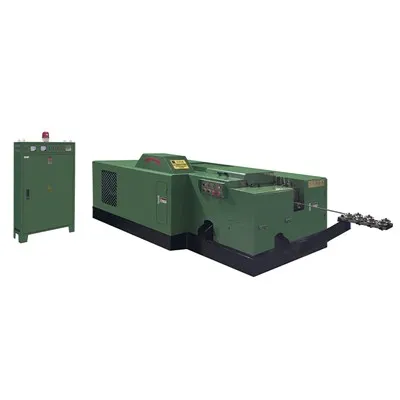
Alright, folks! I’m here as a supplier of Nut Former Machines, and today we’re gonna chat about how to adjust the parameters of these machines. It’s a crucial part of getting the best performance out of your nut former, so let’s dive right in. Nut Former Machine

Understanding the Basics
First off, you gotta know what the main parameters of a nut former machine are. We’re talking about things like the feed rate, the forming force, the die closing time, and the speed of the machine. Each of these parameters plays a vital role in the quality and efficiency of the nut – forming process.
The feed rate is how fast the raw material is fed into the machine. If it’s too fast, the machine might not be able to form the nuts properly, leading to defects. On the other hand, if it’s too slow, you’re not getting the most out of your machine’s capacity, which means lower productivity and higher costs.
The forming force is, well, how much force the machine uses to shape the nuts. It depends on the type of material you’re working with and the size of the nuts you want to produce. Different metals have different hardness levels, so you need to adjust the forming force accordingly.
The die closing time is the duration during which the dies close to shape the nut. This parameter affects the precision of the nut’s dimensions. If the die closing time is too short, the nut might not be fully formed. If it’s too long, it could cause excessive wear on the dies.
The speed of the machine controls how many nuts are produced per unit of time. You’ve got to find the right balance. A higher speed might increase productivity, but it could also lead to more errors if the other parameters aren’t set correctly.
Adjusting the Feed Rate
Let’s start with adjusting the feed rate. Most nut former machines have a control panel where you can set the feed rate. First, you need to check the specifications of the raw material. For example, if you’re using a softer metal, you can generally have a higher feed rate compared to a harder one.
Start by setting the feed rate to a medium value. Then, run a test batch of nuts. Check the quality of the formed nuts. If they look good and the production process seems smooth, you can gradually increase the feed rate to see if you can boost productivity without sacrificing quality. If you notice any issues like incomplete forming or jams in the machine, you’ll need to lower the feed rate.
It’s also important to keep an eye on the consistency of the raw material. Sometimes, even if you’ve adjusted the feed rate correctly, variations in the material’s thickness or hardness can cause problems. In such cases, you might need to make small adjustments on the fly.
Tweaking the Forming Force
When it comes to adjusting the forming force, you need to have a good understanding of the material you’re using. You can start by referring to the machine’s manual, which usually has some guidelines on the recommended forming force for different materials.
If you’re working with a new type of material, you might have to do some trial and error. Start with a low forming force and run a few test pieces. Inspect the nuts to see if they’re being formed properly. If the nuts are under – formed, you’ll need to increase the forming force. But be careful not to go overboard. Too much forming force can damage the dies and also cause the nuts to crack or have other structural issues.
You can also use a force – measuring device to get a more accurate reading of the forming force. This can help you fine – tune the settings and ensure that you’re applying just the right amount of force for each batch of nuts.
Setting the Die Closing Time
The die closing time is a bit trickier to adjust. You need to consider both the speed of the machine and the complexity of the nut’s shape. For simple nut designs, you might be able to get away with a shorter die closing time. But for more intricate shapes, you’ll likely need a longer time to ensure a proper form.
Again, start with a test run. Set the die closing time based on the machine’s default recommendations or what you’ve found works well for similar nuts. Check the precision of the formed nuts. If the dimensions are off, you’ll need to adjust the die closing time. If the nuts are too large, you can try shortening the die closing time. If they’re too small, increase it.
It’s also important to make sure that the dies are in good condition. Worn – out dies can affect the die closing time and the overall quality of the formed nuts. So, regularly inspect and maintain the dies to ensure accurate results.
Controlling the Machine Speed
The machine speed is closely related to the other parameters. You can’t just crank up the speed without considering the feed rate, forming force, and die closing time. If you increase the speed too much, the machine might not have enough time to perform each step properly, leading to poor – quality nuts.
To adjust the machine speed, start by setting it at a moderate level. Then, monitor the production process. If everything seems to be running smoothly and the quality of the nuts is good, you can gradually increase the speed. But keep a close eye on the machine’s performance and the quality of the output.
If you notice any problems like increased vibration, noise, or a drop in nut quality, slow down the machine. You might also need to adjust the other parameters in conjunction with the speed. For example, if you increase the speed, you might need to increase the feed rate slightly to keep up with the production.
Tips for Parameter Adjustment
- Keep detailed records: Every time you make an adjustment to the parameters, write down what you changed and the results. This will help you learn from your experiences and make more informed adjustments in the future.
- Regular maintenance: A well – maintained machine is more likely to give consistent results. Make sure to clean, lubricate, and inspect the machine regularly. This can prevent issues that might require frequent parameter adjustments.
- Training: Ensure that your operators are well – trained in adjusting the machine parameters. They should understand the importance of each parameter and how to make the right adjustments based on the production requirements.
Conclusion
Adjusting the parameters of a nut former machine is a process that requires patience and attention to detail. By understanding the main parameters, such as the feed rate, forming force, die closing time, and machine speed, and following the steps I’ve outlined above, you can optimize the performance of your machine and produce high – quality nuts.
Nut Former Machine If you’re a manufacturer in need of a nut former machine or have any questions about parameter adjustment, don’t hesitate to reach out. We’re here to help you get the most out of your production process. Whether you’re just starting out or looking to upgrade your existing equipment, our team of experts can provide you with the support and guidance you need.
References
- "Industrial Metal Forming Handbook: Process Design and Die Construction"
- "Metal Forming Technology: Theory and Practice"
Wenzhou Rayliter Industrial Co., Ltd.
As one of the leading nut former machine manufacturers and suppliers in China, we also support customized service. We warmly welcome you to buy advanced nut former machine made in China here from our factory. For quotation, contact us now.
Address: 2nd Floor, Building 3, Aoshi Furniture, No. 1001 Kunbei Road, Lingkun Street, Dongtou District, Wenzhou City, Zhejiang Province
E-mail: Rayliter@163.com
WebSite: https://www.rayliter-tech.com/
